




Should you flip your mattress? Most people assume yes, it is what their parents did. But mattress technology has changed.
Most modern mattresses are built with one sleep side only, with soft comfort layers on top and a firm support base at the bottom. Flipping them means sleeping on the wrong side entirely.
What your mattress actually needs is far simpler and takes less than 10 minutes.
Should You Flip Your Mattress?
For most people, the answer is no. And the reason comes down to how mattresses are built today.
Modern mattresses have a fixed layer order. Soft comfort materials sit on top to cushion your body. A dense support base sits beneath the structure to hold it in place. That base is not a sleep surface.
Flipping puts those layers in the wrong position, ruins the comfort layer, and, in most cases, permanently voids the warranty.
Flipping was standard advice when mattresses had usable surfaces on both sides. That design largely disappeared from the market by the early 2000s.
Today, only traditional double-sided innerspring mattresses can be flipped, and only when the manufacturer confirms it. For everything else, rotating is the correct approach.
Which Mattresses Can Be Flipped?
The type of mattress you own determines whether flipping is even an option.
- Double-sided innerspring mattresses can be flipped. Both sides are built for sleeping, so flipping spreads the wear evenly.
- Memory foam mattresses cannot be flipped. The comfort foam sits only on top; the bottom is a dense support base not meant for sleeping.
- Hybrid mattresses cannot be flipped. The coil system sits at the bottom, and sleeping on it would be uncomfortable and damaging.
- Pillow-top mattresses cannot be flipped. The soft pillow layer is sewn onto one side only.
- Latex mattresses cannot be flipped. Some older models have two sides, but most modern ones do not. Always check with your brand first.
If you are unsure, check your mattress label or the manufacturer’s website.
Flipping a memory foam mattress puts you on the hard base and ruins the soft comfort layer underneath. Keep the same side up always. Just rotate it 180 degrees every 6 to 12 months. That is all it needs.
Flipping vs Rotating a Mattress
These two words mean very different things, and mixing them up is where most people go wrong.
| Category | Flipping | Rotating |
|---|---|---|
| What it means | Turning the mattress upside down | Turning the mattress 180 degrees on the same side |
| Sleep surface | You sleep on the other side | You sleep on the same side |
| Best for | Old double-sided mattresses | Modern one-sided mattresses |
| How often | Every 3 to 6 months | Every 6 to 12 months |
| Risk if done wrong | Damages the mattress permanently | No risk |
| Still recommended? | Rarely | Yes, for most mattresses |
Flipping works only for older double-sided mattresses, while rotating suits most modern mattresses.
Why Rotating Your Mattress Matters
Rotating is not just a chore. It is one of the simplest things you can do to protect your sleep and get more life out of your mattress.
Every night you sleep in the same spot, your body weight presses into the same section of foam or springs. Over time, that area compresses faster than the rest. The result is an uneven surface, reduced support, and a mattress that wears out well before it should.
Regular rotation spreads that pressure across the full surface. It slows down body impressions, prevents sagging in one spot, and keeps the mattress feeling consistent from one year to the next.
It also helps maintain the spinal support your body relies on through the night.
A few minutes of effort twice a year can add years to your mattress’s life.
How Often Should You Rotate Your Mattress?
Rotate before you notice a problem, not after. By the time something feels wrong, the damage is already done.
| Mattress Type | How Often to Rotate |
|---|---|
| Memory foam | Every 6 to 12 months |
| Latex | Every 6 to 12 months |
| Hybrid | Every 3 to 6 months |
| Old innerspring | Every 3 to 6 months |
A few factors that may require rotating more frequently:
- Your weight. Heavier sleepers put more pressure on the mattress.
- Shared bed. Two people means faster wear, rotate every 3 to 6 months.
- New mattress. In the first year, rotate every 3 months to help materials settle evenly.
Set a phone reminder. Twice a year works for most people.
Signs Your Mattress Needs Rotating
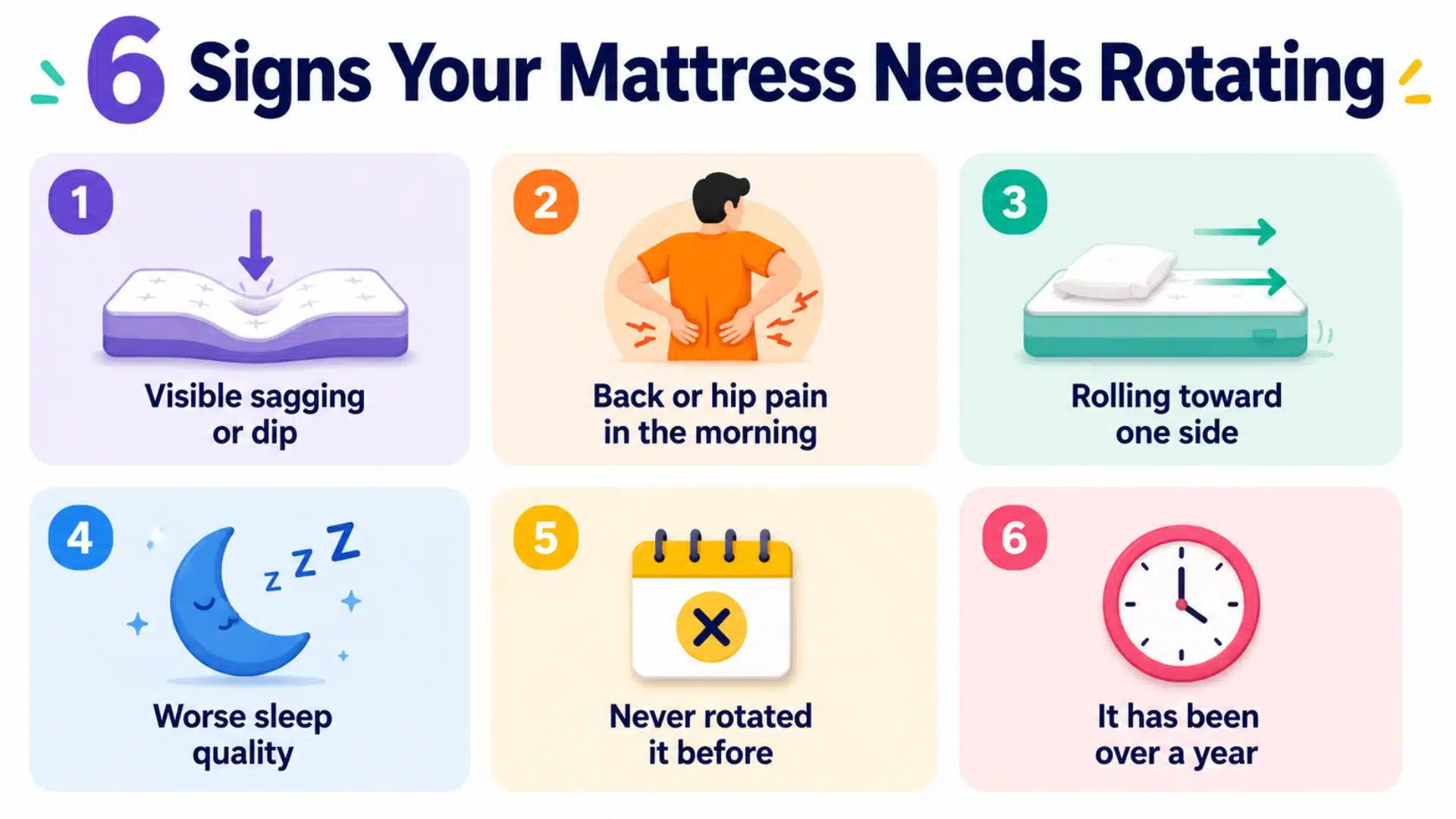
Your body will tell you before your mattress does. Watch for these signs:
- You wake up with a stiff back or sore hips: your mattress is no longer supporting you properly.
- You can see or feel a dip where you sleep: one spot is absorbing all the pressure.
- You keep rolling toward one side: the foam or springs there have worn down more than the rest.
- Your sleep quality has dropped: tossing and turning is a sign that the surface has lost its comfort.
- You have never rotated it: your sleeping spot is far more worn than the untouched areas.
- It has been over 12 months: even if everything feels fine, uneven wear is already building underneath.
The longer you ignore these signs, the harder it becomes to reverse the damage.
Does Flipping or Rotating Help With Back Pain?When a mattress sags or develops a body impression, it stops supporting your spine correctly. The lower back loses its natural alignment, and the muscles around it strain to compensate. That is often the hidden cause of morning stiffness and soreness. Rotating shifts your body onto a firmer, less worn section of the mattress. That change alone can make a real difference. If pain improves after rotating, the surface was the problem. If it does not, a replacement is worth considering. |
How to Rotate Your Mattress
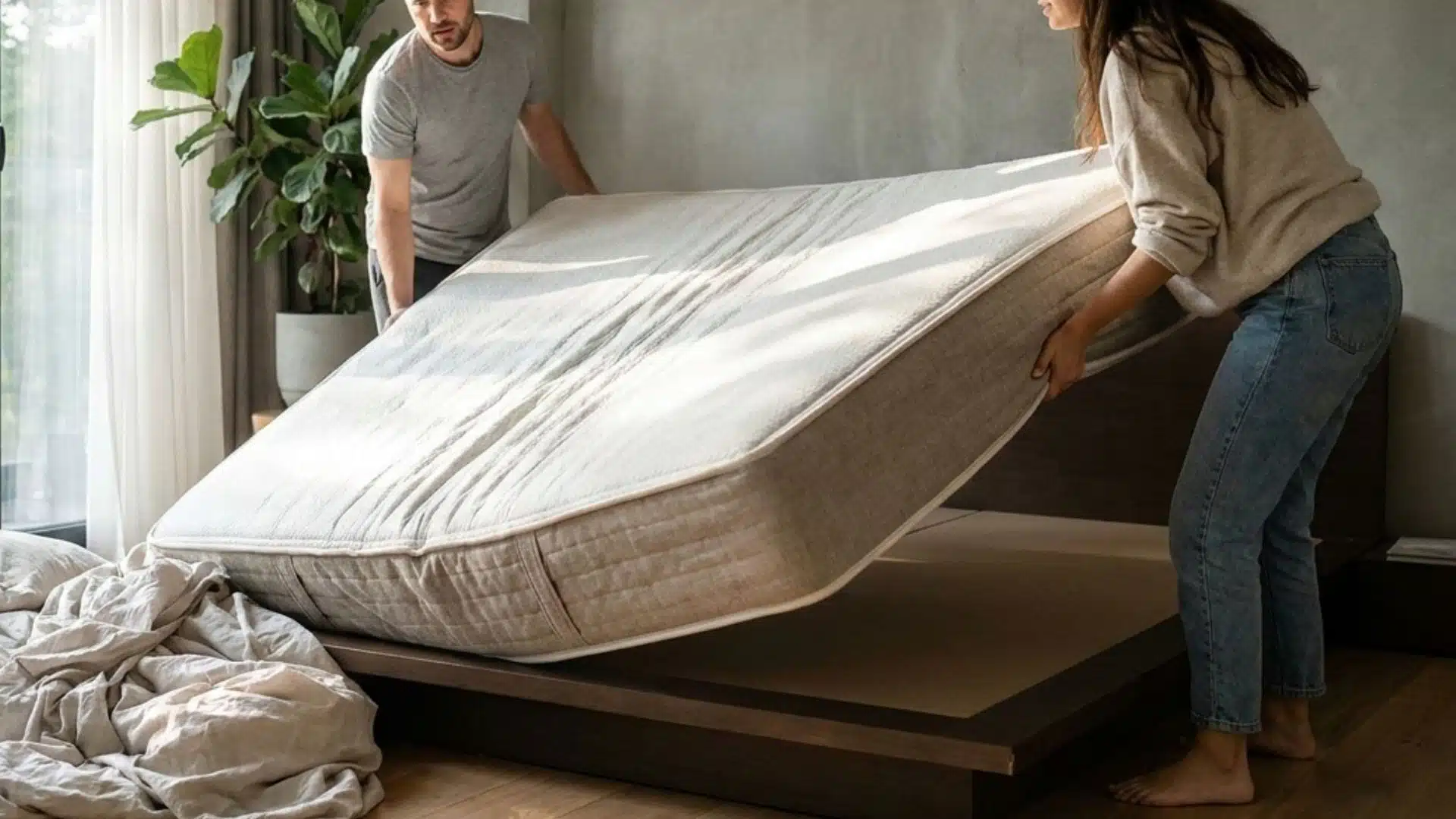
The whole process takes under 10 minutes and requires no tools. Check your mattress label first; some mattresses do not need to be rotated at all.
| Step | What to Do | Why It Matters |
|---|---|---|
| 1. Clear the bed | Remove all sheets, pillows, and bedding | Gives you space to move freely |
| 2. Ask for help | Get one extra person to assist | Mattresses are heavy and awkward alone |
| 3. Rotate 180 degrees | Turn the head end to where the feet were, same side stays up | Ensures even wear across the surface |
| 4. Settle on the frame | Align all four edges with the bed frame | Prevents sagging over the edges |
| 5. Set a reminder | Note the date and schedule the next rotation | Keeps you on track with maintenance |
Final Takeaway
Skip the flip. Rotate on schedule. That one habit protects your mattress, your support, and your sleep for years.
Most modern mattresses need nothing more than a 180-degree rotation every 6 to 12 months. Memory foam and latex twice a year. Hybrids and innerspring mattresses every 3 to 6 months. A few minutes of effort twice a year is all it takes to get the full life out of your mattress.
Your mattress is something you rely on for 6 to 8 hours every single night. Giving it a little attention twice a year is a small effort for a much better return.
Check your mattress type today and set a reminder. If it has been over 12 months since your last rotation, now is the right time to start.
Frequently Asked Questions
Does Flipping a Mattress Void the Warranty?
Yes, it can. Most manufacturers void the warranty if you flip a one-sided mattress. Always check your warranty terms before making any changes.
How Long Does a Mattress Last if You Rotate it Regularly?
A well-maintained mattress lasts 5 to 8 years. Regular rotation slows uneven wear and helps it reach that lifespan comfortably.
Can a Sagging Mattress Be Fixed by Rotating it?
No. Rotation helps prevent sagging, but cannot fix it once it has set in. If your mattress is visibly sagging, rotating it will not restore the original support.