
If you are a doctor, medical coder, or someone trying to understand a diagnosis on a medical bill, you have probably come across the term “sleep disturbance ICD 10.”
Finding the right code matters a lot. It affects how conditions are documented, how insurance claims are processed, and whether a claim is paid.
The short answer: the ICD-10 code for sleep disturbance is G47.9. Sleep Disorder, Unspecified. But there is more to know, depending on the exact situation, and this guide covers it all in simple terms.
What is the ICD-10 Code for Sleep Disturbance?
Several ICD-10 codes are used for sleep-related conditions depending on the patient’s symptoms, medical history, and confirmed diagnosis.
However, the most commonly used code for general or unspecified sleep disturbances is G47.9, especially when the underlying sleep disorder has not yet been clearly identified.
G47.9: Sleep Disorder, Unspecified
G47.9 is a billable ICD-10-CM diagnosis code used for unspecified sleep disorders under the ICD-10-CM classification system used in the United States for medical documentation and insurance billing.
It falls under Chapter 6: Diseases of the Nervous System (G00–G99), which covers neurological and medically related sleep disorders.
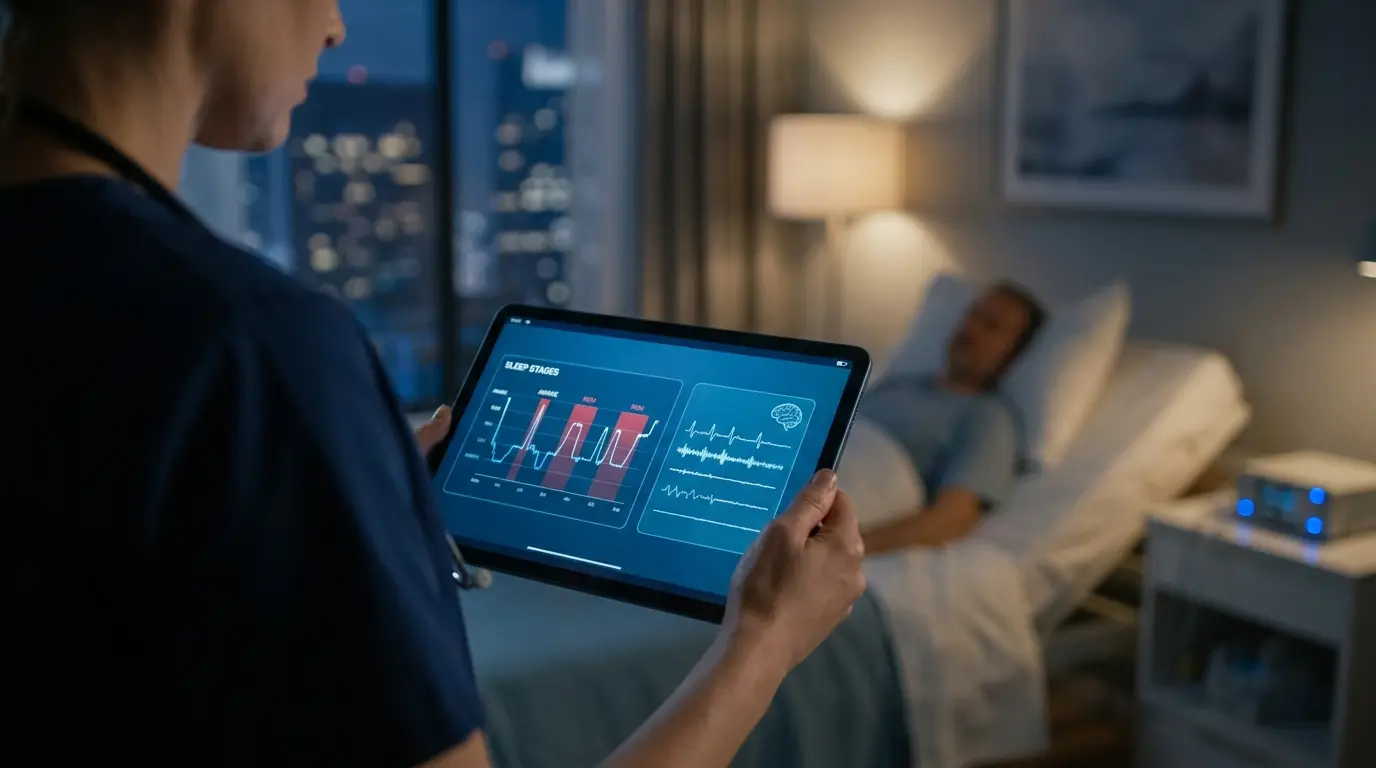
Doctors and healthcare providers typically assign G47.9 when a patient reports symptoms such as poor sleep, disrupted sleep, daytime fatigue, or other sleep-related complaints, but the exact sleep disorder has not yet been confirmed through evaluation, testing, or a sleep study.
The code is commonly used as a temporary or general diagnosis until a more specific condition, such as insomnia or sleep apnea, can be identified.
G47.9 is commonly used when:
- A patient reports poor or disrupted sleep without a confirmed diagnosis
- The provider documents “sleep disturbance” or “sleep problems” without more detail
- A sleep study has not yet been completed, or the results are still pending
- There is not enough documentation to assign a more specific sleep disorder code
- The sleep complaint appears temporary or short-term
G47.9 has been a valid billable ICD-10-CM code since 2016 and remains active for use through 2026. The terms “sleep disturbance” and “sleep disorder NOS (not otherwise specified)” are both commonly associated with this code.
Common Sleep Disorder ICD-10 Codes
Several ICD-10-CM codes are used to classify different types of sleep disorders based on the patient’s symptoms and diagnosis.
The table below highlights some of the most commonly used sleep disorder diagnosis codes in medical billing and clinical documentation.
| Condition | ICD-10 Code | Code Category |
|---|---|---|
| Unspecified sleep disorder | G47.9 | Organic / Neurological |
| Insomnia, unspecified | G47.00 | Organic / Neurological |
| Sleep apnea, unspecified | G47.30 | Organic / Neurological |
| Hypersomnia, unspecified | G47.10 | Organic / Neurological |
| Sleep deprivation | Z72.820 | Lifestyle / Behavioral |
| Circadian rhythm disorder, unspecified | G47.20 | Organic / Neurological |
| Nonorganic sleep disorder, unspecified | F51.9 | Psychological / Behavioral |
| Obstructive sleep apnea (adult) | G47.33 | Organic / Neurological |
| Insomnia due to a medical condition | G47.01 | Organic / Neurological |
| Nonorganic insomnia (primary insomnia) | F51.01 | Psychological / Behavioral |
According to sleep disorder types, they may be divided into three major categories: dyssomnias, which involve insomnia or hypersomnia; parasomnias, which are abnormal sleep behaviors; and sleep disorders secondary to medical or psychiatric disorders.
Note that Z72.820 (sleep deprivation) sits in a separate category. It is used for voluntary or behavioral sleep reduction, not a clinical disorder. Coders should not use it interchangeably with G47.9.
Difference Between G47.9 and F51.9
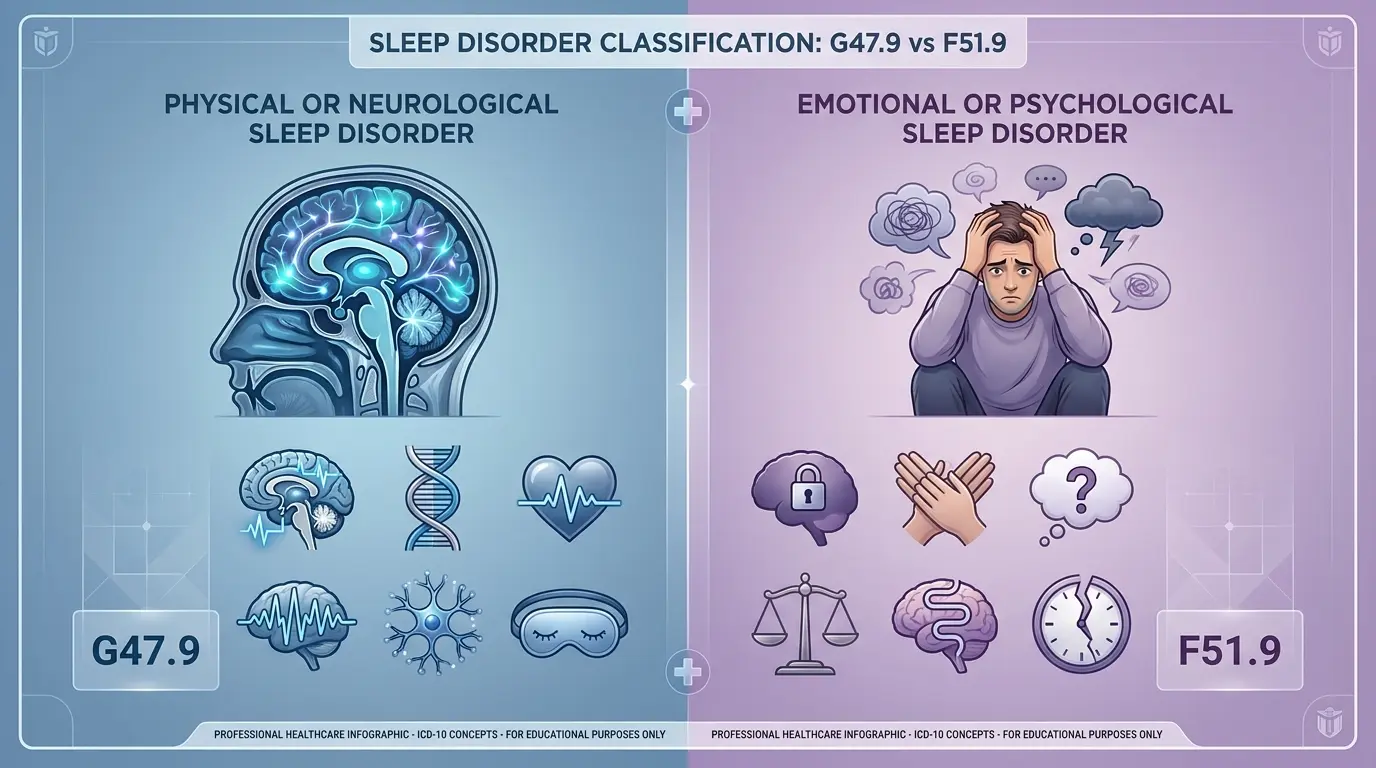
This is one of the most confusing parts of sleep disorder coding. Both codes cover unspecified sleep disorders, but they are from different chapters of the ICD-10-CM.
G47.9: Organic or General Sleep Disorders
G47 codes are used for sleep disorders of physical, neurological, or medically related origin. These codes fall under Chapter 6 of ICD-10-CM: Diseases of the Nervous System (G00–G99).
- Used when the sleep problem has a physical or neurological cause, including medically linked conditions such as sleep apnea that may run in families.
- Can apply when the exact cause of the sleep disturbance is still unknown
- Commonly assigned for conditions like insomnia, sleep apnea, hypersomnia, and general sleep disturbances
- Includes G47.9 for unspecified sleep disorders when no confirmed diagnosis is available
F51.9: Nonorganic Sleep Disorders
F51.9 is used for sleep disorders that are linked to psychological or emotional causes rather than physical or neurological conditions. These codes fall under Chapter V of ICD-10-CM: Mental and Behavioral Disorders (F01–F99).
- Used when emotional, behavioral, or psychological factors cause the sleep problem
- Falls under the “nonorganic sleep disorders” category in ICD-10
- Assigned when no physical condition or substance is responsible for the sleep issue
- The ICD-10 index maps “sleep disturbance” to G47.9, but “sleep disturbance of nonorganic origin” to F51.9
- Helps distinguish mental or behavioral sleep disorders from medically related sleep conditions
In simple terms, G47.9 is generally used for physical or unspecified sleep disorders, while F51.9 is used when the sleep disturbance is primarily psychological or emotional in origin.
Is Sleep Disturbance ICD-10 Code G47.9 Billable?
Yes. G47.9 is a billable ICD-10 diagnosis code, which means it can be used on insurance claims and reimbursement requests.
For a claim to go through without issues, the provider’s documentation needs to support the code. That means the chart notes should clearly mention sleep disturbance, sleep problems, or a related complaint. Vague documentation can lead to claim denials.
As per Medicare coding guidelines, G47.9 is accepted by most payers, including commercial insurers, provided the documentation supports it.
Coders should always make sure the code matches what the provider actually wrote in the notes.
Documentation Tips to Avoid Claim Denials
Claim denials for G47.9 are almost always due to documentation issues, not coding errors. Here is what helps:
- The provider’s note should explicitly mention the sleep complaint using terms such as “sleep disturbance,” “sleep problems,” “disrupted sleep,” or “insomnia.” Ambiguous phrases like “not sleeping well” may not be enough for some payers.
- If a sleep study has been ordered, document that in the note. This supports the use of an unspecified code while awaiting results.
- If a more specific diagnosis has been confirmed at a prior visit, coders should use the specific code at the follow-up visit rather than reverting to G47.9.
Symptoms That May Lead to a Sleep Disturbance Diagnosis
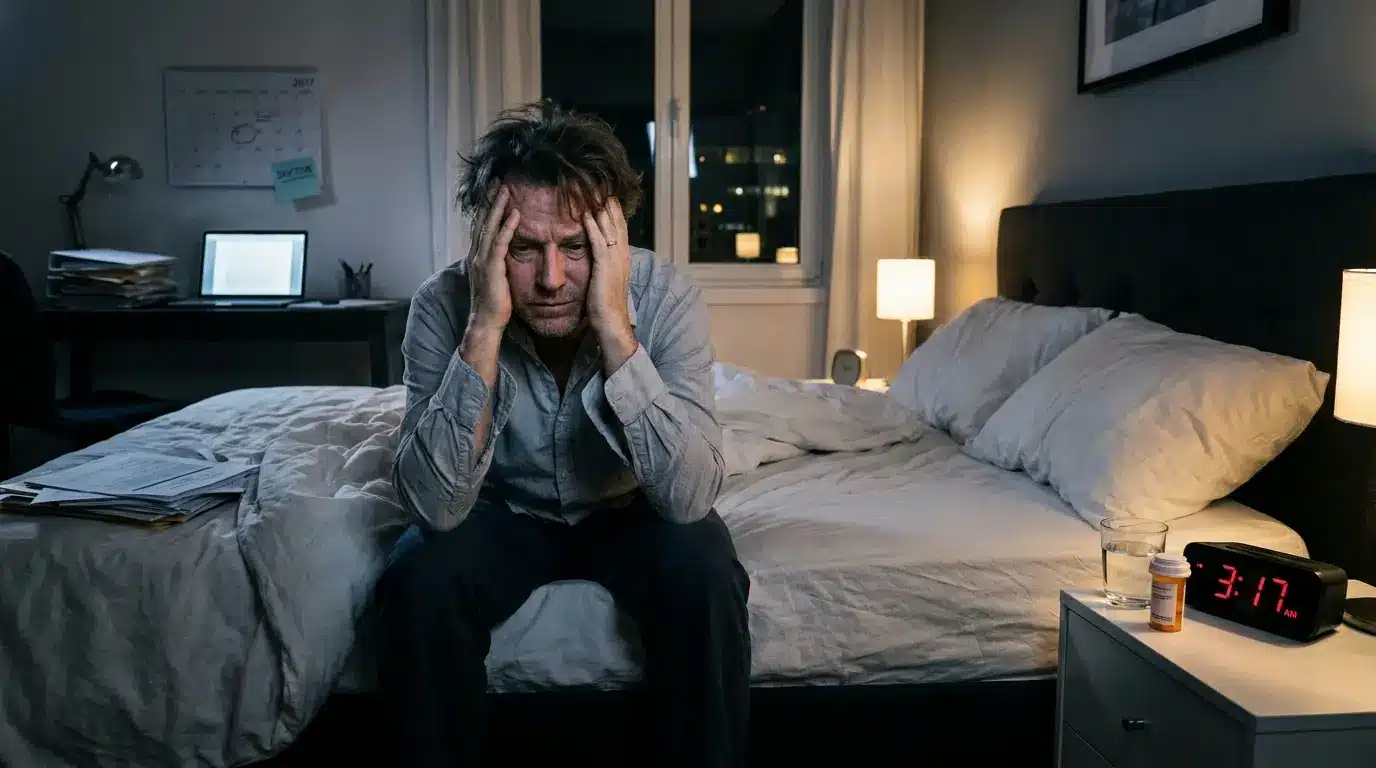
Healthcare providers may assign G47.9 or another related ICD-10 code for sleep when a patient reports symptoms such as difficulty falling asleep, waking up multiple times during the night, waking too early and not falling back asleep, or feeling tired during the day despite getting enough sleep.
Some patients may struggle to fall asleep for long periods, while others experience disrupted or nonrestorative sleep throughout the night.
In general, a sleep disturbance refers to any noticeable change in a person’s normal sleep pattern, including sleeping more or fewer hours than usual or disruptions in the normal stages of sleep.
Related Sleep ICD-10 Codes Doctors Commonly Use
Beyond G47.9, here are the other codes that come up often in sleep-related billing:
- Insomnia: G47.00 is for unspecified insomnia. If insomnia is due to a medical condition, providers assign G47.01 first, followed by an additional code for that condition. Other specified insomnia uses G47.09.
- Nonorganic Insomnia: F51.0 covers insomnia not due to a substance or known physiological condition, and includes primary insomnia under F51.01.
- Sleep Apnea: G47.30 is used for unspecified sleep apnea, while more specific types like obstructive and central sleep apnea fall under the G47.3 category. Sleep apnea is often characterized by loud snoring, interrupted breathing, and daytime fatigue.
- Hypersomnia: G47.10 covers unspecified hypersomnia, which means sleeping too much or feeling excessively sleepy during the day.
- Circadian Rhythm Disorders: G47.20 is the unspecified code. This group also includes shift work sleep disorder (G47.26) and jet lag type (G47.25).
- Narcolepsy: G47.4 covers narcolepsy and cataplexy.
- Parasomnias: Codes G47.50-G47.59 cover abnormal sleep behaviors such as sleep paralysis and REM sleep behavior disorder.
Sleep Issues ICD-10 Codes: Quick Reference by Symptom
Different sleep-related symptoms can point to different ICD-10 diagnosis codes depending on the underlying cause and provider documentation.
The table below provides a quick reference to the most commonly reported sleep complaints and their associated ICD-10 codes.
| Patient’s Chief Complaint | Most Likely ICD-10 Code | Notes |
|---|---|---|
| “I can’t fall asleep.” | G47.00 or F51.01 | G47.00 if physical cause; F51.01 if no physiological cause |
| “I stop breathing in my sleep.” | G47.33 | Obstructive sleep apnea (adult) is the most common type |
| “I sleep too much.” | G47.10 | Unspecified hypersomnia |
| “I can’t sleep because of anxiety.” | F51.9 or F51.01 | Use F codes for psychological origin |
| “My sleep schedule is off.” | G47.20 | Circadian rhythm disorder, unspecified |
| “I just don’t sleep enough” (voluntary) | Z72.820 | Not a disorder; behavioral sleep deprivation |
| Unspecified sleep complaint, pending workup | G47.9 | Use only when no more specific code fits |
These codes are examples only and should always match the provider’s documented diagnosis and clinical findings. When a more specific sleep disorder is confirmed, coders should avoid using general or unspecified codes, such as G47.9.
How Medical Coders Choose the Correct Sleep ICD-10 Code
Picking the right code is not guesswork. Coders follow a clear process:
Medical coders assign sleep ICD-10 codes based on the provider’s documentation, symptom details, and confirmed diagnosis. If a specific disorder, such as insomnia or sleep apnea, is documented, coders should use the most specific code available rather than an unspecified diagnosis such as G47.9.
Coders must also determine whether the sleep issue is physical, neurological, or psychological in origin, as this affects whether a G47 or F51 code is appropriate.
As stated in the official coding guidelines, G47.9 is a valid billable code; it should be used only when insufficient information is available to assign a more specific diagnosis.
Good documentation from the provider makes the coder’s job easier and reduces the chance of a claim denial.
Coding Decision Process
Medical coders follow a step-by-step process to assign the most accurate ICD-10 code for a sleep disorder based on the provider’s documentation and confirmed diagnosis. The goal is to avoid unspecified coding whenever a more detailed diagnosis is available.
- Read the provider’s note in full. Look for any specific diagnosis language before defaulting to an unspecified code.
- Identify the cause. Is the sleep issue physical or neurological? Use G47.x. Is it psychological or emotional? Use F51.x.
- Check for a confirmed diagnosis. If the provider has written “obstructive sleep apnea,” “insomnia,” or any other named condition, assign the specific code.
- Use G47.9 only as a last resort. It is appropriate when the complaint is documented, but no specific disorder has been confirmed, or the results of a sleep study are still pending.
- Verify the code is supported by documentation. The chart note must contain language that maps to sleep disturbance. “Fatigue” alone is not sufficient to support G47.9.
Using the correct coding process helps reduce claim denials, improve documentation accuracy, and ensure the diagnosis reflects the patient’s actual condition as closely as possible.
Final Thoughts
G47.9 is the most widely used ICD-10 code for sleep disturbance and general sleep disorders. It is billable, valid for 2026, and appropriate when a patient has sleep problems but no confirmed specific diagnosis.
That said, coders and providers should always aim for the most specific code the documentation supports. If insomnia, sleep apnea, or another disorder has been confirmed, use the matching code instead of defaulting to G47.9.
Disclaimer: This content is for informational purposes only. Medical coding should always follow official ICD-10-CM guidelines and be based on provider documentation. When in doubt, consult a certified medical coder or coding compliance resource.
Frequently Asked Questions
Can G47.9 Be Used as a Primary Diagnosis Code?
Yes, G47.9 can be used as a primary diagnosis code when sleep disturbance is the main reason for the visit. However, a more specific diagnosis code should be used if the exact sleep disorder is confirmed.
What Chapter of ICD-10 Does Sleep Disturbance Fall Under?
Most sleep disturbance codes, including G47.9, fall under Chapter 6: Diseases of the Nervous System. Nonorganic sleep disorders are classified under Chapter 5: Mental and Behavioral Disorders.
Does G47.9 Require a Sleep Study for Diagnosis?
No, a sleep study is not always required before assigning G47.9. Providers may use the code based on documented symptoms when the exact sleep disorder has not yet been identified.