





Most new parents ask when babies sleep through the night around the three-month mark, right when the tiredness really hits.
Many babies start sleeping longer stretches at night between four and six months, but six months isn’t a deadline.
Your baby may still wake because they’re hungry, need comfort, are teething, feel unwell, or are simply going through a change in their sleep.
Even babies who were sleeping well can suddenly start waking more around this age. Parents commonly call this temporary shift the 6-month sleep regression.
When Do Babies Sleep Through the Night?
Somewhere between four and six months, a lot of babies start sleeping in longer chunks. Some get there earlier. Some take a bit longer, and that is still normal.
Here is something worth clearing up early. Babies are not required to sleep through the night by six months, and plenty don’t.
A 2018 study in the journal Pediatrics followed nearly 400 infants and found that at six months, 38 percent were not yet sleeping at least six consecutive hours at night.
It also helps to know that “sleeping through the night” usually doesn’t mean twelve quiet hours. Most pediatric sources define it as roughly five to six hours without waking.
Babies move through lighter and deeper sleep all night, and during the lighter parts they can stir, sigh, or make noise without fully waking up. Parents sometimes rush in during this window and wake a baby who would have settled back down on their own.
A baby waking at night does not automatically mean their sleep development is behind. A 2022 study in Acta Paediatrica followed more than 1,500 Norwegian infants from 6 to 24 months and found no clear evidence linking early sleep problems to developmental delays. Night waking at six months is common enough that it is not, on its own, a warning sign.
Baby Sleep at 2 to 12 Months: What to Expect
Six months doesn’t happen in isolation. Sleep changes gradually across the whole first year, and it helps to see where six months fits into that bigger picture.
Age | Total Sleep in 24 Hours | What’s Typical |
|---|---|---|
2 to 3 months | 14 to 17 hours | Sleep comes in short 50 to 60 minute cycles; day and night patterns are just starting to form |
3 to 6 months | 12 to 15 hours | Daytime naps settle into 2 to 3 stretches; some babies manage a 6-hour night stretch by 6 months |
6 to 12 months | 11 to 14 hours | Most babies are ready for bed between 6 pm and 10 pm; naps narrow to 2 to 3 a day. |
Keep that reframe in mind as you read the six-month specifics below, since much of what feels like backsliding is just this stage running its course.
What Should Sleep Look Like Around Six Months?
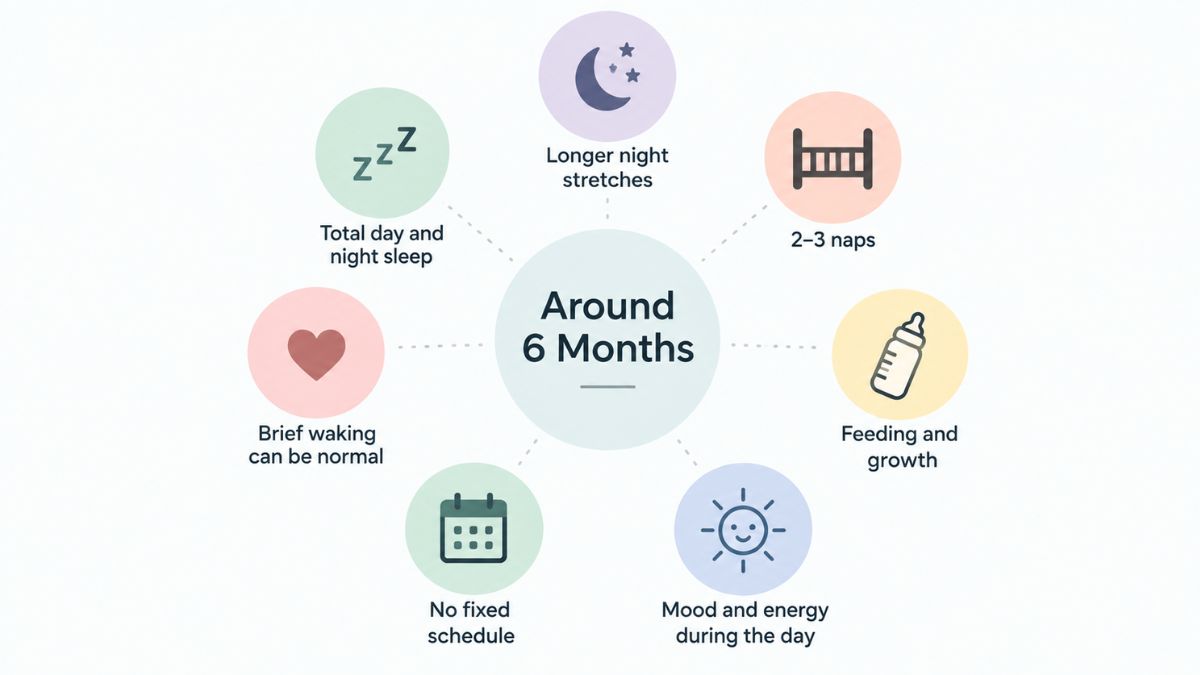
By six months, sleep tends to look more settled than it did in the newborn stage. Most babies this age need a good amount of total sleep spread across the night and a couple of naps. Night sleep often stretches out while naps become more predictable.
Brief waking between sleep cycles is still normal. No set number of night wakings fits every baby at this age. Some six-month-olds resettle on their own. Others still need a feeding or some comfort to fall back asleep, and that is fine too.
Instead of chasing a specific schedule, it helps to look at the whole picture:
- Total sleep across day and night
- How feeding is going
- Growth and weight gain
- Mood and energy during the day
- Nap quality
- The longest stretch your baby manages at night
- If the waking is new, or just how your baby has always slept
No single six-month sleep schedule fits every baby, so use this list as a guide, not a checklist.
Why Is My Six-Month-Old Waking at Night?
Night waking at this age rarely comes down to one single cause. It is usually a mix of a few things happening at once.
Possible Reason | What Parents May Notice |
|---|---|
Hunger | Baby settles quickly after a feeding |
New developmental skills | More rolling, sitting, or general movement |
Teething or discomfort | Extra fussiness, drooling, gum rubbing |
Illness | Sleep changes alongside other symptoms |
Overtiredness | Rough Bedtime, frequent waking overnight |
Nap changes | Daytime shifts and night sleep gets unsettled |
Light or noise | Baby wakes more easily than usual |
Trouble resettling | Baby wants the same help at 2 a.m. that they got at Bedtime |
Babies move through different sleep stages all night. Bedtime brief waking during those shifts does not automatically mean something is wrong.
In fact, Nationwide Children’s Hospital notes that all babies wake briefly four to six times a night, and the real difference is between babies who resettle on their own (“self-soothers”) and babies who call out for help getting back to sleep (“signalers”).
If your baby was sleeping fine and then suddenly is not, that shift is often the first sign of a sleep regression, which is the next thing to cover.
What Is the 6 Month Sleep Regression?
The 6-month sleep regression is a term parents use for a period of rougher sleep that can show up around this age. It is not a medical diagnosis, and not every baby experiences it.
If you already went through the four-month regression, some of these sleep changes may feel familiar, although every stage can look a little different.
Some babies suddenly wake more often, struggle to settle, or have changes in their naps, while others barely show any difference.
There is no fixed timeline either. For some babies, disrupted sleep lasts only a few days, while for others it can continue for a few weeks. Some babies may even start sleeping better around six months.
The key difference is the change in your baby’s usual pattern. Simply waking at night does not automatically mean your baby is going through a sleep regression.
Signs You May Notice
A sleep regression often shows up as a noticeable change from your baby’s usual sleep pattern rather than one isolated rough night.
- Waking more often at night than before
- Taking longer to settle at Bedtime
- Sleeping well for a while, then suddenly waking more often
- Naps becoming shorter or less predictable
- More fussiness around naps or Bedtime
These changes can come and go, and not every baby will show all of them. What matters most is noticing whether the pattern is different from your baby’s usual sleep.
Is It a Sleep Regression or Something Else?
Not every rough night deserves the “regression” label. Sometimes it is teething, a schedule change, or a short illness passing through. Here is a simple way to sort it out:
More Like a Temporary Sleep Change | Worth Checking Further |
|---|---|
Baby is feeding normally | Poor feeding or refusing bottles/breast |
New skill or routine change | Signs of illness |
Temporary extra waking | Breathing problems |
Normal daytime behavior | Unusual sleepiness during the day |
Sleep slowly improves over days | Waking keeps getting worse, not better |
Teething, travel, a shifted nap, hunger, and general discomfort can all look similar on the surface.
That trend tells you more than any single hard night, and it is the best clue for deciding to ride it out or call your pediatrician.
How Can I Help My Baby Sleep Longer at Night?
Simple, consistent habits can make settling and night waking easier over time.
- Keep Bedtime Familiar: Follow the same short routine each night, such as feeding, a diaper change, dim lights, and a book or song.
- Keep Nights Calm: Use low lights and quiet voices during feeds or diaper changes so nighttime stays associated with sleep. A comfortable room matters too, so pay attention to the sleeping temperature along with light and noise.
- Protect Daytime Sleep: Regular naps and suitable awake periods can help prevent overtiredness, which may make Bedtime and night waking harder.
- Check Daytime Feeding: Make sure feeds aren’t rushed or reduced while you’re trying to encourage longer nighttime stretches.
- Notice How Your Baby Falls Asleep: Some babies look for the same rocking, feeding, or holding when they briefly wake during the night.
- Pause Before Responding: Brief stirring does not always mean your baby is fully awake. Give them a moment unless they seem hungry, uncomfortable, or distressed.
Stick with changes for several nights rather than changing the routine after one rough night.
When Can Babies Sleep Through Without Feeding?
Longer stretches of sleep and dropping night feeds are separate milestones, and they don’t always happen together. A few things determine if a baby still needs a night feeding, including age, growth pattern, weight gain, how much they eat during the day, feeding method, and any health history worth factoring in.
Some babies naturally stretch out between feeds as they grow. Others are still waking to eat at six months, and that is not a sign that anything is wrong. Age alone isn’t enough reason to drop a feed.
If you are considering intentional night weaning, especially if you have concerns about growth or feeding, it is worth a quick conversation with your pediatrician first.
Safe Sleep Matters More Than Longer Sleep
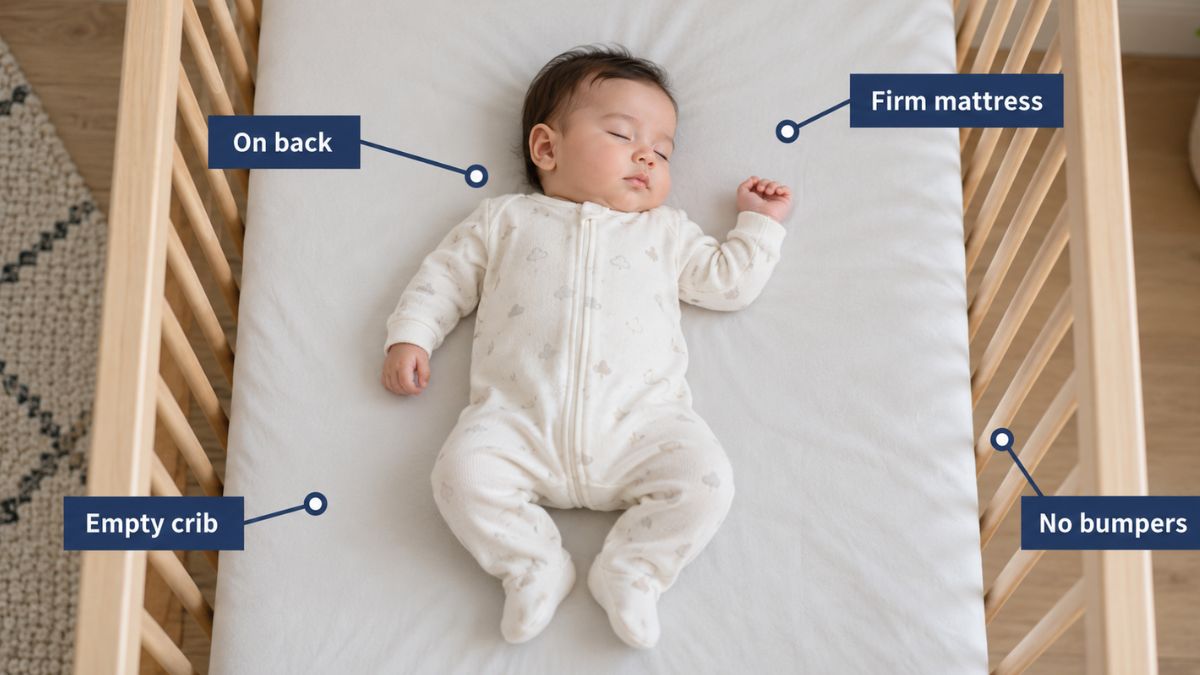
No sleep strategy is worth cutting corners on safety. The basics, according to the American Academy of Pediatrics, still apply well past the newborn stage:
- Always place babies on their backs for every sleep
- Use a firm, flat sleep surface, nothing inclined
- Keep pillows, blankets, bumpers, toys, and other soft items out of the sleep space
- Give your baby their own separate sleep space rather than sharing your bed
- Skip inclined sleepers or sleep positioners marketed as sleep helpers; they are not proven safe
- Room sharing without bed sharing is the safer setup during early infancy
None of these guidelines are about squeezing out extra hours of sleep. They focus on keeping your baby safe every night.
When Should I Call the Pediatrician?
Most night waking is nothing to worry about, but a few signs are worth calling your pediatrician. Breathing difficulty, gasping, or unusual pauses in breathing during sleep should never be ignored.
Persistent or unusually loud baby snoring is also worth mentioning, especially if it comes with gasping, pauses in breathing, or restless sleep.
The same goes for poor feeding, concerns about growth, fewer wet diapers than usual, a fever or other signs of illness, unusual trouble waking your baby, ongoing distress that does not ease, or any big, unexplained change in your baby’s normal behavior.
A six-month-old simply waking at night on their own is not automatically a medical problem. It is the pattern and the symptoms alongside it that matter, not the waking by itself.
Final Thoughts
There is no single answer to when babies sleep through the night, but longer stretches tend to show up as babies pass the four- to six-month mark.
Six months is a helpful reference point, not a deadline your baby has to meet. Night waking can trace back to feeding, development, illness, discomfort, or a temporary rough patch like the 6-month sleep regression.
Safe sleep matters more than chasing extra hours, no matter what stage your baby is in. Watch your baby’s pattern over several nights instead of judging one hard evening, and call your pediatrician if sleep changes come with feeding or growth concerns.
Common Questions Parents Ask
What Time Should a 6-Month-Old Go to Bed?
Most 6-month-olds settle best with bedtime between 6 pm and 8 pm. Watch for sleepy cues like eye rubbing or fussing rather than a fixed clock time.
Do Formula-Fed Babies Sleep Through the Night Sooner?
Sometimes. Formula may take longer to digest than breast milk, which some parents find helps with longer stretches between feeds. Timing still varies widely from baby to baby, and both feeding methods can lead to good sleep.
When Should I Stop Night Feeds?
There’s no fixed age. It depends on weight gain, growth, and daytime intake. Talk to your pediatrician before dropping feeds, especially before 6 months.