
Have you ever caught someone sleeping with their eyes open? It looks strange, almost unsettling. But what if you wanted to do it on purpose? Or what if you are already doing it without knowing?
Sleeping with your eyes open is more common than you think. Some people do it because of a medical condition. Others try to learn it intentionally for a quick nap during the day.
Either way, there is a lot to know about its causes, the signs to watch for, and what you can do about it. Both sides of the story are worth knowing.
Is it Really Possible to Sleep With Your Eyes Open?
Yes, it is possible. Studies show that about 20 percent of people sleep with their eyes open, including babies. Most cases are partial; the eyes stay open just a crack, and many people never realize it.
But here is the thing. Your eyes are not built for this. Every time you blink, a thin layer of fluid coats your eyes and keeps them healthy.
At night, closed eyelids do the same job. They block light, hold moisture, and help your body stay in deep sleep.
When your eyes stay open at night, that process breaks down. Your eyes dry out, light sneaks in, and your sleep gets disrupted.
So yes, it happens. But it is not how your body is supposed to work.
Why Do Some People Sleep With Their Eyes Open?
Not everyone who sleeps with their eyes open does it on purpose. In most cases, a medical condition or external factor is responsible.
- Nocturnal Lagophthalmos: This is the most common cause. It is a condition where the eyelids cannot fully close during sleep. Some people are born with it, while others develop it later in life. It can affect one eye or both.
- Bell’s Palsy: Bell’s Palsy weakens or paralyzes the nerves that control facial movement. As a result, the eyelids lose the ability to close completely at night. The good news is that the outlook is generally positive, 70 to 85 percent of people recover completely even without treatment, and over 95 percent recover fully with proper medical care.
- Stress: High stress levels keep your body in a state of alertness even during sleep. This prevents you from reaching the deep stages of sleep. When your sleep stays shallow, your eyelids may not fully relax and close.
- Sleep Paralysis: During sleep paralysis, your body becomes temporarily frozen between sleep and wakefulness. Your muscles stop responding, including the muscles around your eyelids. This means your eyes can remain open at the transition between sleep and waking, since muscle control has not yet fully returned
- Injury or Surgery Near the Facial Nerves: A stroke, accident, or surgery close to the facial nerves can damage the muscles that control eyelid movement. Once these nerves are affected, fully closing the eyes during sleep becomes difficult, or sometimes impossible, without medical treatment.
- Graves’ Disease: This thyroid condition causes the eyes to bulge forward, making it physically difficult for the eyelids to cover the eyes completely during sleep. It is one of the more commonly overlooked causes of nocturnal lagophthalmos.
- Floppy Eyelid Syndrome: This condition causes the eyelids to become unusually loose and weak. It is often linked to obesity and obstructive sleep apnea, and it prevents the eyelids from forming a proper seal during sleep.
These causes vary from person to person. Knowing the reason behind it is the first step to finding the right fix.
Signs You Are Sleeping With Your Eyes Open
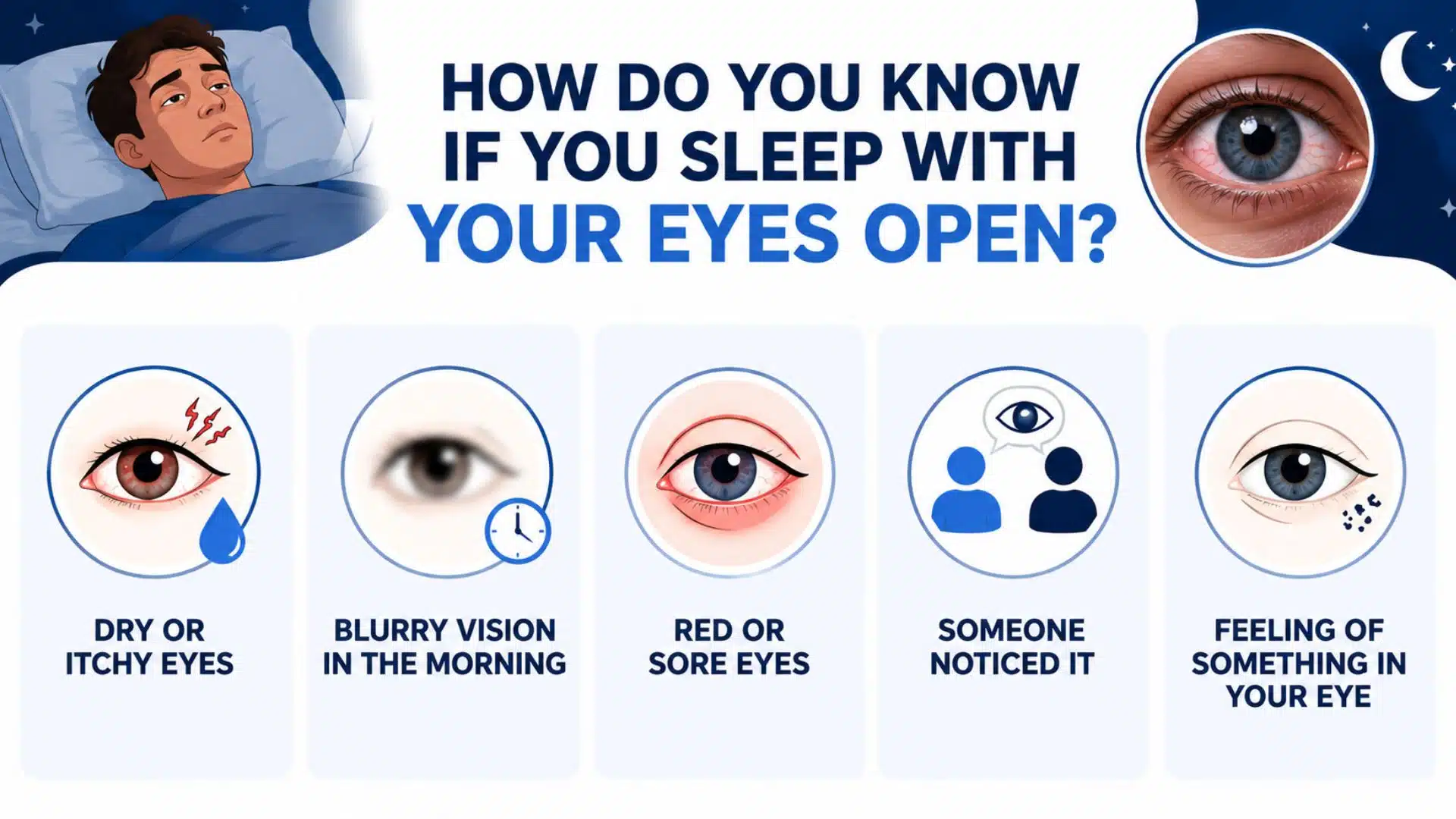
Your body leaves clues every single morning. Here is what to look for before brushing them off as nothing.
- Dry or itchy eyes every morning mean your eyes lost moisture during the night.
- Blurry vision that takes time to clear after waking up is a common sign.
- Red or sore eyes in the morning indicate irritation from overnight exposure.
- If someone notices your eyes are open while sleeping, take that as a clear sign.
- A gritty feeling in your eye when you wake up means dust settled on it overnight.
If you notice even two or three of these signs regularly, your eyes may be staying open while you sleep..
Side Effects of Sleeping With Your Eyes Open
Ignoring this condition does not make it go away. The effects build up quietly and become harder to treat the longer they go unaddressed.
| Short-Term Effects | Long-Term Effects |
|---|---|
| Burning or stinging sensation after waking up | Permanent corneal scarring from repeated exposure |
| Increased sensitivity to bright light in the morning | Chronic dry eye disease requiring ongoing medical treatment |
| Watery or teary eyes as the body tries to compensate | Progressive loss of visual sharpness over time |
| Swollen or puffy eyelids from overnight irritation | Higher risk of recurring eye infections and ulcers |
| Difficulty keeping eyes open comfortably after waking | Corneal nerve damage leading to reduced eye sensation |
The longer this condition goes untreated, the greater the risk of irreversible damage to your vision. And while this is a uniquely human problem, the animal kingdom offers a fascinating contrast worth knowing about.
Animals That Sleep With One Eye OpenUnlike humans, who sleep with their eyes open due to a medical condition, certain animals have evolved to do it on purpose, and with remarkable precision. The word lagophthalmos comes from lagos, the Greek word for hare, once believed to sleep with its eyes open. That has since been debunked. According to ScienceInsights, dolphins, seals, and migratory birds do so through unihemispheric slow-wave sleep, resting one hemisphere while the other remains alert. As Discover Magazine reports, for aquatic animals, it is pure survival. Scientific American even found traces of this ability in humans. |
Home Remedies and Medical Treatments for Sleeping With Eyes Open
Not every case needs a doctor. Start with what you can do at home tonight, and step up to medical options only if the problem continues.
At-Home Remedies
- Artificial tear drops: Apply lubricating eye drops right before bed to keep the eye surface moist and protected throughout the night.
- Sleep mask or moisture goggles: A well-fitting mask completely seals out dust, air, and light, creating a protective environment around your eyes while you sleep.
- Warm compress: Place a warm cloth over your eyes for five to ten minutes before bed to relax the muscles around your eyelids and encourage natural closure.
- Relaxation techniques: Deep breathing, meditation, or light stretching before sleep can lower stress levels and help your body reach deeper, more restful stages of sleep.
- Medical eyelid tape: Gently securing the eyelids shut with surgical tape is a simple, doctor-recommended short-term fix for mild cases.
Medical Treatments
- Gold-weight implants: Small weights are surgically placed inside the upper eyelid and use gravity to assist natural closure during sleep and blinking. Gold is specifically chosen because it is MRI-safe and gentle on eyelid skin. The implant can be adjusted or removed if eyelid function improves over time.
- Botox injections: Administered into the eyelid-lifting muscle, Botox creates a mild and controlled droop that helps the eyelid close during sleep. Results are temporary, lasting three to six months, and must be managed by a qualified doctor.
- Surgery: Recommended for serious or permanent cases such as Bell’s Palsy, stroke, or tumor-related nerve damage where the eyelid cannot close without structural correction.
Always speak to a doctor before starting any medical treatment. Home remedies are effective only for mild and temporary cases.
When Should You See a Doctor?Most people ignore the signs until the problem gets worse. See a doctor if your eyes feel dry, red, or irritated every single morning. If someone has noticed your eyes staying open during sleep more than once, do not ignore it. Blurry vision that does not clear up quickly after waking or any visible redness, soreness, or a constant gritty feeling needs professional attention. Early diagnosis protects your eyes from permanent damage. Visit the American Academy of Ophthalmology at aao.org for trusted, doctor-reviewed information on sleep and eye health |
Final Thoughts
Sleeping with your eyes open is more common than most people think. It can happen because of a medical condition, stress, or nerve damage. In some cases, people even try to do it on purpose for a quick nap.
The key is to pay attention to the signs. Dry eyes, blurry vision, and redness every morning are your body’s way of telling you something is off. Do not brush these signs aside.
Simple fixes like eye drops, a sleep mask, or a warm compress can help with mild cases. But if the problem keeps coming back, seeing a doctor is always the right move.
Your eyes work hard all day. Give them the rest and care they deserve at night.