




One day your baby takes two naps without a problem. Then suddenly, the second nap turns into a daily battle.
You spend 30 minutes trying to settle them, only for bedtime to get pushed later anyway.
Some search for when to transition to 1 nap, but the answer is the same either way.
There is no magic age, but many babies make the switch sometime between 13 and 18 months.
The tricky part is knowing if your baby is actually ready or just going through a rough week of sleep.
How Much Sleep Do Babies Need Before the Transition?
Before focusing on naps, it helps to look at total sleep. The AAP recommends 12 to 16 hours of sleep per day for babies aged 4 to 12 months, including naps.
For toddlers aged 1 to 2, the CDC recommends 11 to 14 hours in 24 hours.
As babies grow, their overall sleep needs gradually decrease. That often means daytime sleep changes first, with two shorter naps eventually becoming one longer midday nap.
This is also why the switch does not happen at one exact age. Some babies reach that lower sleep need sooner, while others comfortably keep two naps for longer.
When Do Babies Transition to One Nap?
Most reputable sources, including pediatric sleep consultants and major parenting publications, converge on 13 to 18 months as the core window for dropping to one nap.
Twelve months is possible, but it’s early for most babies. Some toddlers don’t fully settle into one nap until 18 months or a little beyond, and that’s still within the range of normal.
Daycare timing complicates this a little. Many daycare centers move every child in a room to one nap around the 12-month mark, simply because group schedules need consistency, not because every 12-month-old is individually ready.
If your baby is in daycare and seems to be adjusting fine, that’s a good sign their body was closer to ready than the calendar alone would suggest.
How the One-Nap Transition Can Look From 12 to 18 Months

Data and expert ranges are useful, but you asked what this actually looks like in someone else’s house, so here’s what I watched happen with three real babies, plus what the typical pattern looks like at each stage.
Around 12 Months
A small share of babies are genuinely ready this early, usually because their morning nap has already stretched long and their nighttime sleep is solid.
My sister’s younger son, Theo, was one of these early droppers.
He started resisting his afternoon nap right around 12 and a half months. That kind of smooth transition is possible this early, but it is not the typical experience.
His nighttime sleep never wavered through the change, and within about two weeks he’d settled into a single, nearly three-hour midday nap.
What made his case unusual wasn’t the age; it was that he showed almost no rough patch at all, which is not the typical experience.
Around 13–14 Months
Most sleep consultants place the true start of the transition window here, since babies this age usually have the stamina for longer wake windows without becoming overtired. My friend’s daughter, Alex, fits this pattern closely.
She began fighting her morning nap around 13 months. By 14 months, one consolidated afternoon nap was working consistently, though she went through about ten days of shorter, choppier naps before it stabilized.
Around 15 Months
Plenty of toddlers land in the middle of the range, often bouncing between one and two naps for a few weeks before settling into a firm pattern.
My sister’s older son, Milo, transitioned around 15 months, and his in-between stretch some days one nap, some days two lasted almost three weeks before his schedule held steady.
Closer to 18 Months or Later
Some babies simply need both naps for longer, and that isn’t a sign anything is wrong.
Later transitioners often have shorter individual naps to begin with, so their bodies still need two rest periods to reach their daily sleep total well past their first birthday.
Is Your Baby Ready to Drop to One Nap?
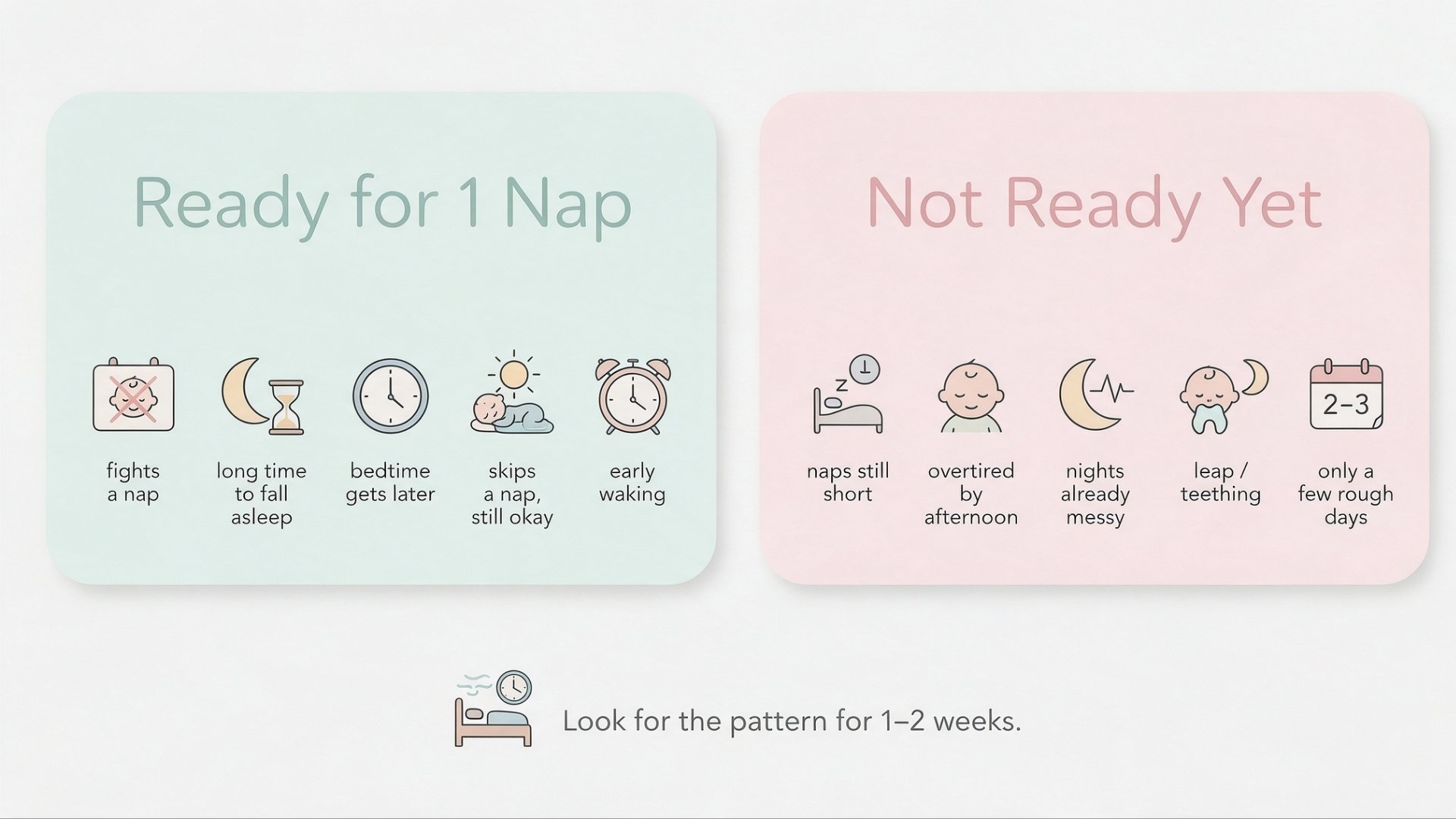
Watching for a consistent pattern over a week or two, rather than judging a single rough day, is the most reliable way to tell if your baby is genuinely ready or just going through a temporary rough patch a sleep regression tied to a developmental leap, teething, or illness.
Regressions are common around this age and usually pass on their own without any schedule change.
Signs your baby may be ready:
- Consistently fighting or refusing one of the two naps for a week or more
- Taking 30 to 45 minutes or longer to fall asleep at nap time
- Bedtime creeping later because the second nap runs too close to it
- One nap is regularly skipped without your baby seeming overtired afterward
- Early morning waking that doesn’t resolve with small schedule tweaks
Signs your baby may not be ready yet:
- Naps are still short, with no signs of lengthening
- Skipping a nap leads to a clearly overtired, miserable afternoon
- Nighttime sleep is already inconsistent or disrupted
- Your baby seems to be mid-leap new words, new steps rather than showing a true sleep shift
- The rough patch is brand new and hasn’t held steady for at least a week or two
If you’re seeing the readiness signs nearly every day for one to two weeks straight, and your baby is at least 12 to 13 months old, that’s typically the point where working toward one nap makes more sense than continuing to fight for two.
What the Two-to-One Nap Transition Actually Looks Like
Knowing the general shape of this shift ahead of time makes the weeks that follow much easier to sit through.
- It’s gradual, not instant: Most babies pass through an in-between phase, two naps some days, one nap on others, for two to four weeks before things settle.
- The morning nap shifts later first: You’ll typically push the first nap 15 to 30 minutes later every few days until it merges naturally with where the afternoon nap used to sit.
- Wake windows lengthen noticeably: Babies on one nap generally need four to six hours of awake time before and after their single nap, compared to the shorter windows two-nap babies handle.
- Short naps are common at first: The first one-nap days often produce a shorter nap than you’d like while your baby’s body adjusts to the new rhythm.
- Bedtime may need to move earlier: On days the single nap runs short, moving bedtime up by 30 to 45 minutes helps prevent overtiredness before sleep.
What Does a One-Nap Schedule Look Like?
Once your baby is fully transitioned, often somewhere between 15 and 18 months, a fairly consistent framework tends to emerge. Your baby’s exact times will shift based on their own wake-up and bedtime, but this is a realistic starting point.
This is also a natural point to check that your baby’s sleep setup still fits them, including whether their crib blanket measurements still match their stage.
Time | Activity |
|---|---|
7:00 AM | Wake up for the day |
7:00 AM – 12:30 PM | Morning wake window (activities, meals, outdoor time) |
12:30 – 2:30 PM | One consolidated midday nap |
2:30 – 7:00 PM | Afternoon wake window |
7:00 – 7:30 PM | Bedtime routine and lights out |
How to Transition From Two Naps to One
- Push the morning nap later in small increments: Shift the first nap by 15 to 30 minutes every few days rather than jumping straight to a midday schedule. This gives your baby’s body time to adjust without becoming overtired in the process.
- Keep the nap-time routine consistent: A familiar wind-down, even a shortened version of your usual one, tells your baby it’s time to rest even as the clock time keeps shifting.
- Offer an earlier bedtime on short-nap days: If the single nap ends up brief, moving bedtime up by 30 to 45 minutes helps prevent a cascade of overtiredness and night waking.
- Expect some rough days and stay flexible: A day that reverts to two shorter naps during the adjustment period isn’t a failure. It’s a normal part of your baby’s body recalibrating to a new rhythm.
- Give it two to three weeks before you reassess: Most transitions take several weeks to fully settle, so resist judging the new schedule based on the first few days alone.
What If Your Baby Is in Daycare?Daycares often move every child in a room to one nap around 12 months, regardless of individual readiness, since group schedules need consistency across the whole class. If your baby seems to adjust fine there, you can typically mirror that same one-nap rhythm at home. If they come home overtired and cranky, an earlier bedtime on daycare days or a second nap at home on weekends can help bridge the gap until their body catches up. |
|---|
When to Talk to Your Pediatrician
Most nap transitions are purely developmental and don’t need a medical conversation.
Still, check in with your pediatrician if your baby shows extreme fatigue that doesn’t improve with schedule changes, if their total daily sleep is consistently falling well below the 11-to-14-hour range recommended for toddlers, or if you notice snoring, gasping, or other signs that might point to a sleep-related breathing issue rather than a typical transition.
Final Thoughts
No single schedule works for every baby, and that’s the main takeaway.
The best time to make the change depends on sleep totals, nap length, mood, wake windows, and how consistently your baby handles the day.
Knowing when do babies transition to one nap is useful, but watching your own baby matters more than following an age chart too closely.
Give the change a little time, expect a few uneven days, and adjust as needed. If your baby has already made the switch, share what age it happened at in the comments.
Frequently Asked Questions
What Is the 60 Minute Nap Rule?
The 60 minute nap rule means keeping your baby in the crib for at least 60 minutes at nap time, even if they wake early, to give them a chance to link sleep cycles. It is a guideline, not a strict rule for every baby.
Do Daycare and Home Nap Schedules Need to Match Exactly?
No. Daycare and home schedules can differ by 30 minutes to an hour without causing lasting problems. Consistent total daily sleep matters more than matching nap times exactly.
My Baby Is 15 Months Old, and Naps Are Still Under 45 Minutes. What Should I Do?
Try extending the wake window by 15 to 20 minutes for a few days before dropping to one nap. If short naps continue alongside other readiness signs, consolidation may be appropriate.
Can the Nap Transition Affect Appetite or Mood, Not Just Sleep?
Yes. Temporary irritability or appetite changes can happen during the first one to two weeks as wake periods lengthen. Discuss persistent appetite changes with your pediatrician.
Can a Baby Go Back to Two Naps After Starting One?
Yes. If your baby becomes consistently overtired or starts waking earlier, temporarily adding a short second nap can help before attempting the one nap transition again.