





Two-year-olds can make nap time feel completely unpredictable. One day, they sleep for two hours without a fuss.
The next, they stand in the crib, talk to themselves, and refuse to settle at all.
That does not always mean they are ready to stop napping.
A steady 2-year-old nap schedule can still make a big difference in mood, bedtime, and overall sleep.
The key is getting the timing, nap length, and routine right for your toddler’s day instead of forcing a schedule that no longer fits.
Quick answer: Most 2-year-olds need 11 to 14 hours of sleep a day about 10 to 12 hours at night, plus a 1- to 3-hour nap. One nap, timed around midday, works for nearly all toddlers this age.
Do 2-Year-Olds Still Need Naps?
At two, kids are learning fast. New words, big feelings, and new physical skills all show up within the same few months. Sleep lets their brains sort it all out.
A dependable 2-year-old nap schedule does more than fill an afternoon hour.
It keeps moods steadier, meals more predictable, and bedtime shorter. Skip naps too often, and you’ll usually see the opposite: more meltdowns, more stalling at bedtime, and a toddler who wakes up cranky no matter how long they slept.
The payoff shows up later too. Toddlers who keep a steady nap routine tend to give up the nap more smoothly when the time finally comes, usually well after their second birthday.
How Long Should a 2-Year-Old Nap?
The American Academy of Pediatrics and the American Academy of Sleep Medicine set the standard here: toddlers ages 1 to 2 need 11 to 14 hours of sleep in a 24-hour day, naps included, and that total sleep need keeps shifting as kids get older.
For a 2-year-old, that usually breaks down like this:
Sleep type | Typical range |
|---|---|
Nighttime sleep | 10–12 hours |
Daytime nap | 1–3 hours |
Total sleep | 11–14 hours |
Most toddlers settle into a single nap of about 1.5 to 2.5 hours once they’re fully off two naps.
A nap much shorter than an hour usually isn’t enough to reset the afternoon. A nap longer than three hours can start eating into the sleep your toddler needs at bedtime.
These numbers are averages, not rules. Watch your toddler, not the clock. A child who wakes up cheerful after 90 minutes may be fully rested.
One who’s still rubbing their eyes and whining after two and a half hours might need more time or an earlier nap the next day.
Wake Windows and the Best Nap Time for a 2-Year-Old
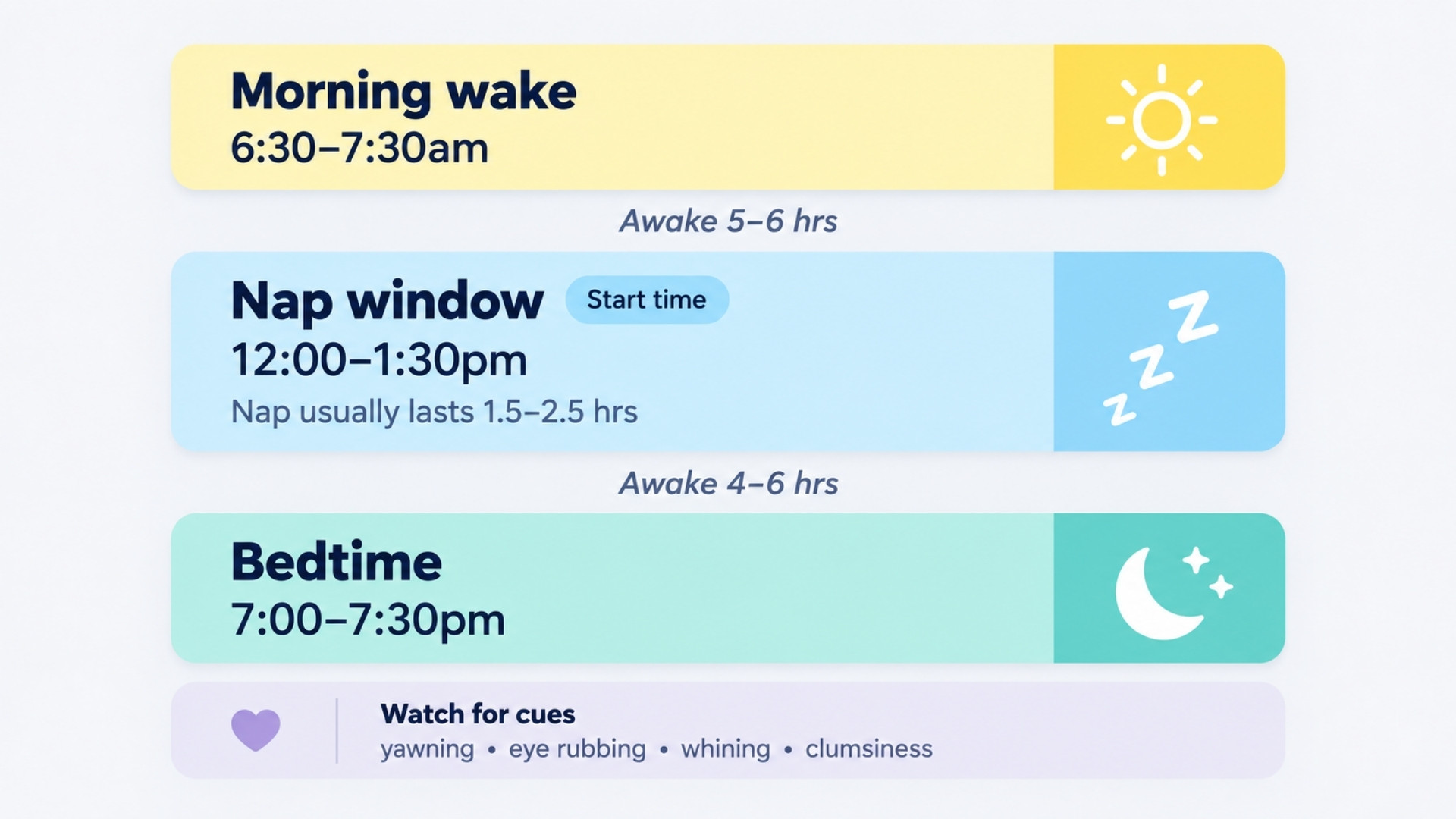
Two things decide when your toddler should nap: how long they’ve been awake, and the clock.
- Wake windows: Most 2-year-olds can handle about 5 to 6 hours of awake time before the midday nap starts to feel necessary. After the nap, most can stay awake another 4 to 6 hours before bedtime. Push much past either window, and you’ll usually get a toddler who’s too wound up to settle, not less.
- Nap timing: For most families, that lands the nap somewhere between 12:00 and 1:30 p.m. right after lunch, when the body’s natural afternoon dip in alertness kicks in.
Watch for these cues about 20 to 30 minutes before that window:
- Rubbing eyes or yawning
- Sudden clumsiness or bumping into things
- Whining or short patience with siblings or toys
A nap offered too early often means a wide-awake toddler at bedtime. One offered too late often means a meltdown before they ever fall asleep. Track your child’s pattern for a week, and you’ll know their real window better than any chart.
2-Year-Old Nap Schedules That Actually Fit Real Life
Every toddler’s day looks a little different, but here’s what works for most families with a 2-year-old.
One-nap schedule (the norm at this age)
Time | Activity |
|---|---|
6:30–7:30 a.m. | Wake for the day |
12:00–1:00 p.m. | Nap begins (1.5–2.5 hrs) |
7:00–7:30 p.m. | Bedtime |
Quiet-time backup (for nap-resistant days)
Time | Activity |
|---|---|
6:30–7:30 a.m. | Wake for the day |
12:30–1:00 p.m. | 20–30 minutes of quiet, low-key time in a dim room |
6:15–6:45 p.m. | Earlier bedtime to cover the missed nap |
This is a sample schedule and intended as a general guideline. Every baby is unique and may have different sleep patterns and needs. Parents should observe their child’s cues and adjust the schedule accordingly.
Nap Strike or Sleep Regression? Here’s the Difference

If your toddler suddenly fights a nap they used to take without a fuss, you’re probably not looking at a toddler who’s outgrown napping. You’re looking at the 2-year sleep regression.
This regression is common enough that most pediatric sleep guidance treats it as a normal, temporary stage, not a red flag.
It often shows up alongside a language boost, a new molar, separation anxiety, or a jump in independence.
Signs include:
- Suddenly refusing a nap they’ve always taken
- Fighting bedtime harder than usual
- Waking more at night
- Waking earlier in the morning
- Extra clinginess or big emotions during the day
The fix isn’t to drop the nap. Keep offering it at the same time every day, even on rough days. Most regressions clear up within two to six weeks once your toddler adjusts to whatever’s driving it.
Genuine readiness to drop the nap for good usually doesn’t show up until somewhere between 2.5 and 4 years old. Most toddlers still need daytime sleep well past their second birthday.
What’s Actually Disrupting Naps at This Age
A few things tend to collide right around age two, and any one of them can throw off a previously solid nap:
- A language explosion: New words and ideas can make toddlers too wired to wind down.
- Separation anxiety: Many toddlers go through a phase of not wanting to be left alone in a quiet room.
- Molars: Two-year molars often come in during this window, and the discomfort can turn an easy nap into a fight.
- A push for independence: Toddlers are testing limits everywhere, including whether nap time is really non-negotiable.
- Routine changes: A daycare switch, a new sibling, or travel can knock a solid schedule off track fast.
Most of these are temporary. The nap schedule that worked last month will usually work again once the phase passes, as long as you keep offering it.
Building a Nap Routine Your Toddler Will Recognize
A short, repeatable routine tells your toddler’s body that sleep is coming next. That predictability cuts down on stalling more than almost anything else you can try.
Set the same cues every time
- Use one phrase, like “nap time now,” said the same way each day
- Dim the lights 5–10 minutes before the nap starts
- Hand over the same comfort item, a blanket or stuffed animal, used only for sleep
- Read one short, calm book instead of screen time or active play
- Nap in the same crib or toddler bed every day
Set up the room to help
- Block outside light with blackout curtains, so afternoon sun doesn’t signal “wake up”
- Add steady white noise to mask household sounds
- Get your toddler outside in bright morning light soon after waking; it helps set their body clock for the day
- Keep weekend nap times close to weekday ones, so Monday isn’t a reset
- Keep the 20 minutes before the nap calm and low-energy, not a wrestling match
Most toddlers start settling faster within a week or two of a routine like this, simply because their body already knows what’s coming next.
What to Do When Your 2-Year-Old Fights the Nap
A little nap resistance around age two is normal. These adjustments usually bring it back without turning every afternoon into a standoff.
- Offer quiet time instead of sleep: Twenty to thirty minutes of calm, low-stimulation time in a dim room still helps, even without sleep.
- Keep the nap window steady: Offer it at the same time daily. Steadiness wins out over a few resistant days.
- Re-check the wake window: A nap offered too early or too late often gets refused simply because your toddler isn’t ready yet.
- Watch for overtiredness: An earlier bedtime for a few nights can reset a toddler who’s become too wound up to settle for naps.
- Tell regression apart from readiness: Occasional refusal during a rough patch is normal. Refusal that holds steady for two weeks or more, with no other clear cause, is worth watching more closely, though true nap-dropping is still rare before age 2.5.
Most nap strikes pass within two to six weeks. Staying calm and steady matters more than any single trick.
When to Talk to a Pediatrician
Occasional nap resistance is normal and rarely needs a doctor’s visit. A few patterns are worth bringing up at your toddler’s next checkup, though:
- Loud, persistent snoring, gasping, or pauses in breathing during sleep — these can be signs of obstructive sleep apnea in toddlers and are worth mentioning at the next visit or sooner if frequent
- Disrupted naps and nighttime sleep that continue for several weeks despite a steady routine
- Sudden, major sleep changes paired with other new symptoms, like appetite loss or unusual lethargy
You know your toddler’s normal better than any chart does. If something feels off and doesn’t match anything here, it’s always reasonable to ask.
Final Thoughts
A good 2-year-old nap schedule comes down to timing, consistency, and watching your toddler’s sleep cues.
Wake windows, nap length, and bedtime all work together, so small adjustments can make a big difference.
Nap resistance is common at this age and does not always mean the nap is over for good.
Keep the routine steady, watch for patterns, and adjust when needed. If you have a nap routine that works well for your toddler, share it in the comments.
Frequently Asked Questions
My Toddler Still Naps Twice a Day at 24 Months. Is That a Problem?
Not necessarily, but it is uncommon. Most toddlers transition to one nap between 15 and 18 months. Gradually delay the morning nap by 15 minutes every few days to move toward a midday nap.
Is It Okay for Naps to Happen in a Crib Instead of a Toddler Bed?
Yes. A crib can be a good option for naps as long as your toddler stays safely inside. When you switch to a toddler bed, keep the same nap routine to make the transition easier.
My Toddler Only Naps in the Car. Is That a Problem?
An occasional car nap is fine. If it becomes routine, try replacing the motion with a stroller walk or short drive before nap time, then move your toddler to bed when they’re drowsy.
What Should I Do About Very Short Naps, Like 30 to 45 Minutes?
Check whether your toddler is napping too early or too late. Shifting nap time by 15 minutes in either direction can sometimes help extend a short nap.
Should Naps Be Skipped Entirely on Travel Days?
Skipping one nap is usually fine, but an earlier bedtime can help. When possible, let your toddler take a short nap in the car seat or stroller during travel.