


Most people know how bad it feels to miss a night of sleep. You feel tired, unfocused, and emotionally drained.
But extreme sleep loss can sometimes lead to something far more serious called sleep deprivation psychosis.
This condition happens when a person stays awake long enough for the brain to struggle separating reality from hallucinations or delusions.
Symptoms can include paranoia, confusion, hearing voices, or seeing things that are not there.
While it is usually temporary, severe sleep deprivation can become dangerous without proper rest and medical support.
What Is Sleep Deprivation Psychosis?
Sleep deprivation psychosis is when your brain loses touch with reality due to extreme lack of sleep.
You may see things that are not there. You may hear sounds no one else can hear. You may believe things that are not true.
Sleep deprivation psychosis is not considered a primary psychotic disorder like schizophrenia. Instead, it is a temporary condition triggered by extreme sleep loss.
The longer you stay awake, the worse it gets.
How Long Does it Take for Sleep Deprivation Psychosis to Set in?
Every hour without sleep puts more pressure on your brain. Here is what happens over time:
| Time Without Sleep | What Happens |
|---|---|
| 24 hours | Irritability, trouble focusing, low mood |
| 36-48 hours | Anxiety, mood swings, and early sensory distortions begin |
| 72 hours | Hallucinations, paranoia, and delusions begin |
| 96 hours and beyond | Full loss of reality, severe psychotic symptoms |
According to a 2018 systematic review published in Frontiers in Psychiatry by Waters et al., perceptual distortions, anxiety, and irritability typically start within 24 to 48 hours of sleep loss.
Complex hallucinations and disordered thinking follow between 48 and 90 hours. Delusions generally appear after 72 hours, at which point the clinical picture starts to resemble acute psychosis.
Most people start feeling the serious effects around the three-day mark. But everyone is different. Some people may feel symptoms earlier. Others may hold on a little longer. One thing is clear. The more sleep you lose, the higher the risk.
What Causes Sleep Deprivation Psychosis?
Sleep deprivation psychosis does not happen out of nowhere. There is always a reason your body is not getting the rest it needs.
- Lifestyle Choices: Pulling all-nighters, working night shifts, or studying through the night can all add up over time.
- Health Conditions: Insomnia, anxiety, and chronic pain make it hard to sleep. When left untreated, the risk grows.
- Substance Use: Stimulants and stronger substances keep your brain wired and awake for days.
- Stress Hormones: Sleep loss raises cortisol levels, keeping your brain in a constant state of alert.
- Circadian Rhythm Disruption: Irregular schedules can throw your internal clock completely off.
- Neurological Overstimulation: Without rest, neurotransmitters fall out of balance, and the brain becomes overwhelmed.
Any one of these can trigger the condition. In many cases, more than one cause is at play at the same time.
Who Is Most at Risk?
While sleep deprivation psychosis can happen to anyone, certain groups face a higher chance of reaching dangerous levels of sleep loss.
Shift workers, especially those rotating between day and night schedules, face ongoing disruption to their circadian rhythms.
People living with untreated insomnia, anxiety disorders, or chronic pain often struggle to get enough deep sleep, meaning the deficit builds over time without a single “sleepless night” ever triggering concern.
Those using stimulant substances, whether prescription or recreational, are also at higher risk because the substances actively block the brain signals that drive the urge to sleep.
If you already live with a mood disorder or a history of psychotic episodes, your threshold for sleep-related symptoms may be lower.
Sleep loss is a known trigger for mood episodes in conditions like bipolar disorder, and the interaction between an existing vulnerability and severe sleep deprivation can accelerate symptom onset.
Common Symptoms of Sleep Deprivation Psychosis
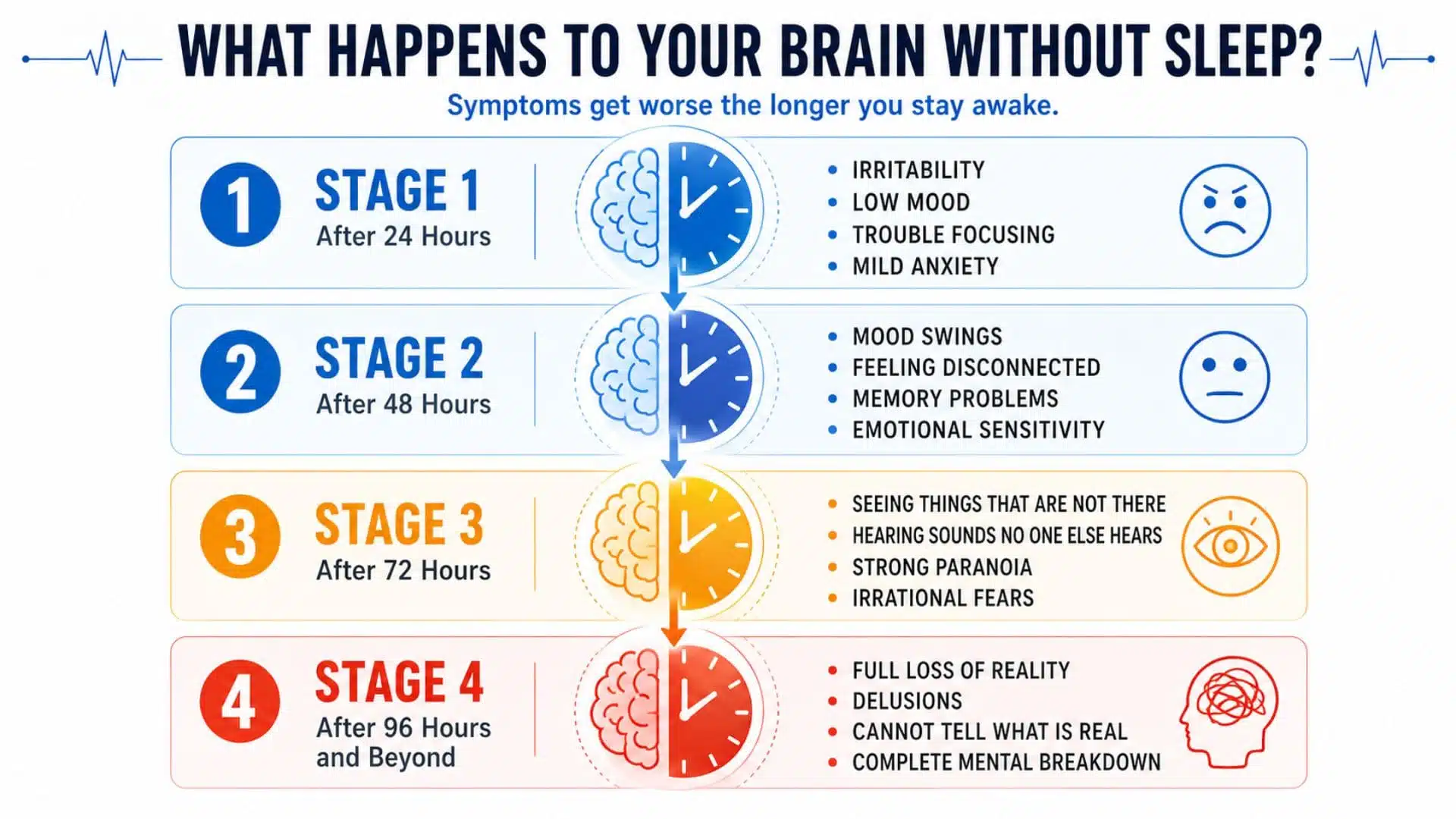
Sleep does more than rest your body. It keeps your mind stable and your thoughts clear. When that rest is taken away, the brain begins to break down slowly.
- Irritability: Small things feel unbearable. Your patience disappears and your mood shifts without warning.
- Trouble Focusing: Simple tasks take twice as long. Your mind drifts, and thoughts become impossible to hold.
- Feeling Disconnected: You feel detached from yourself and your surroundings. Nothing around you feels fully real.
- Paranoia: You feel watched or targeted without reason. Trust in the people around you starts to break down.
- Hallucinations: You see shapes, hear voices, or sense things no one else can. Your brain begins creating its own reality.
- Delusions: You start believing things that are not true. These beliefs feel completely certain and cannot be reasoned away.
- Complete Loss of Reality: You can no longer tell what is real. Basic perception breaks down entirely.
These symptoms do not all arrive at once. They build gradually with every passing hour of lost sleep. The longer you stay awake, the worse it gets.
Sleep Deprivation Psychosis vs. Regular Hallucinations
People often mix these two up. They are not the same thing. Here is a simple breakdown of how they differ.
| Feature | Regular Hallucinations | Sleep Deprivation Psychosis |
|---|---|---|
| Awareness of reality | Still intact | Completely lost |
| Cause | Fever, stress, substances | Extreme lack of sleep |
| Severity | Mild to moderate | Severe |
| Delusions present | Rarely | Very commonly |
| Duration | Short and temporary | Lasts till sleep is restored |
| Risk to daily life | Low | High |
| Needs medical help | Sometimes | Almost always |
Think of regular hallucinations as a warning sign. Sleep deprivation psychosis is the emergency itself. The sooner you recognize the difference, the sooner you can take the right action and get proper help.
What Kind of Hallucinations Can Sleep Deprivation Cause?
Not all hallucinations look the same. Sleep deprivation can affect multiple senses at once, and the type you experience often depends on how long you have been awake.
Research shows that visual hallucinations are the most common, reported in 90% of sleep deprivation studies. Somatosensory hallucinations come next, followed by auditory ones.
Visual: Seeing shapes, shadows, or figures that are not there. Colors may look distorted. Objects may appear to move.
Auditory: Hearing voices, sounds, or music that no one else can hear. Some people hear their name being called.
Tactile: Feeling sensations on the skin. Crawling, tingling, or pressure with no physical cause.
Olfactory: Smelling something that does not exist in the room.
By the third day without sleep, hallucinations across all three main sensory categories are commonly reported.
These are not random. They follow a pattern. The longer you stay awake, the more intense and real they feel.
Does Sleep Deprivation Psychosis Go Away?
For most people, yes. Sleep deprivation psychosis is temporary, and the brain has a real ability to recover once it gets proper rest.
Here is what recovery generally looks like:
Step 1: Get Sleep: The moment you allow your body proper rest, the healing begins. Most people see improvement within 24 hours.
Step 2: Symptoms Fade: Hallucinations, paranoia, and confusion typically clear up within 1 to 3 days with consistent sleep.
Step 3: Full Recovery: Most people return to feeling completely normal within a week. No lasting damage in most cases.
One important note, though. If symptoms stay even after sleeping, that is a sign that something deeper may be going on. See a doctor without delay.
Treatment Options for Sleep Deprivation Psychosis
Recovery starts with sleep, but depending on how severe the symptoms are, professional support may also be needed.
For mild cases caught early, the approach is straightforward. Get to a safe environment, remove anything that is keeping you awake, and allow the brain to rest. Most mild cases resolve on their own within a few days of consistent sleep.
For more severe cases, a doctor may recommend Cognitive Behavioral Therapy for Insomnia (CBT-I), which is a structured program that addresses the thought patterns and behaviors driving poor sleep.
CBT-I is considered a first-line treatment for chronic insomnia and has been shown to reduce psychotic-like experiences in people who struggle with persistent sleep problems.
In cases where hallucinations or delusions are severe, and the person cannot sleep without intervention, short-term medication may be used to help stabilize the situation.
This is a medical decision made case by case and is not a long-term fix on its own. If an underlying condition, such as anxiety, depression, or bipolar disorder, is contributing to the sleep loss, treating that condition is part of recovery too.
Sleep deprivation and mental health can feed into each other in a cycle that is hard to break without addressing both sides.
How to Prevent Sleep Deprivation Psychosis
Prevention comes down to protecting your sleep before it becomes a crisis.
Keep a consistent sleep schedule, going to bed and waking at the same time each day, even on weekends. This keeps your circadian rhythm stable and makes it easier for the brain to shift into rest mode at the right time.
Create an environment that supports sleep. Cool, dark, and quiet rooms signal to your nervous system that it is time to wind down.
I often recommend a short herbal tea ritual before bed to my clients, not as a cure, but as a consistent wind-down cue the body starts to recognize over time.
Avoid caffeine in the afternoon and limit screen exposure in the hour before bed. Both keep the brain in an alert state when it should be slowing down.
If you notice your sleep has been consistently poor for more than two weeks, do not wait it out. Address it early, whether through lifestyle changes or by speaking with a doctor, before the deficit builds into something more serious.
When Should You Seek Help?
Do not wait until things get unbearable. If you have not slept properly for three or more days, that is already a sign to act.
Signs You Need Immediate Medical Help
Early support can prevent symptoms from getting worse and help the brain recover faster. |
Learn more about sleep disorders and mental health to understand the full picture.
Conclusion
Sleep is not a luxury but a necessity. It is something your brain cannot function without.
When sleep deprivation goes too far, your brain does not just get tired. It starts to break down. You lose focus, then clarity, then your grip on reality itself.
The signs are always there before things get serious. Mood changes, disconnection, confusion. Your body is asking for help long before the crisis hits.
The good news is that this condition is reversible. Most people recover fully with proper rest and the right support.
Do not ignore the signs. Do not push through endless sleepless nights thinking it will sort itself out.
Frequently Asked Questions
Is Sleep Deprivation Psychosis the Same as Schizophrenia?
No. Schizophrenia is a chronic mental health condition. Sleep deprivation psychosis is temporary and directly caused by extreme sleep loss. Once sleep is restored, symptoms typically resolve completely.
Can One Bad Night of Sleep Cause Psychosis?
No. A single poor night causes fatigue and irritability, but not psychosis. Psychotic symptoms require prolonged sleep loss, usually spanning multiple consecutive days without adequate rest.
Can Sleep Deprivation Psychosis Cause Permanent Damage?
In most cases, no. The brain recovers fully with proper sleep. However, repeated or prolonged episodes over time may increase the risk of lasting cognitive and emotional difficulties.